Why Ingredient Lists Put Some Names First
Cosmetic ingredient lists put some names first for a reason. Learn what order can suggest, where it stops being useful, and what to check before buying.
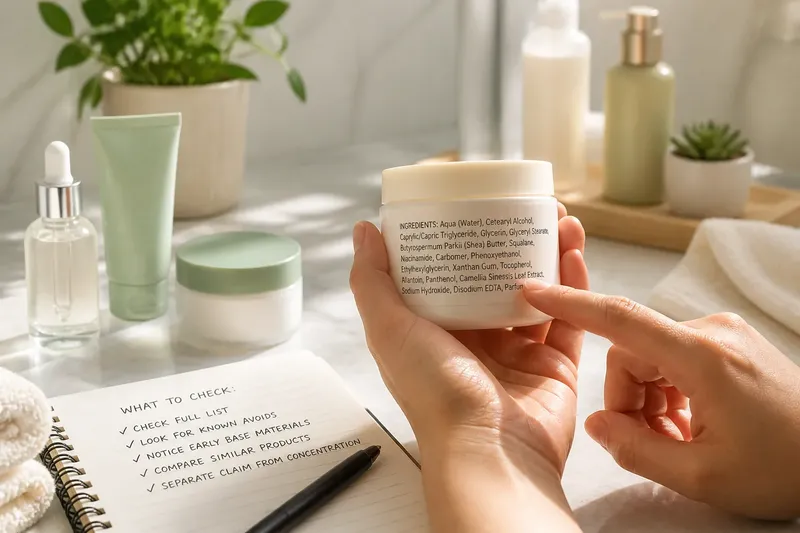
Cosmetic ingredient lists put some names first because labels generally arrange ingredients by the amount used, from more to less. That order can help you understand a formula, but it is not a scorecard: a name near the top is not automatically better, and one near the bottom is not automatically unimportant.
What does the order on a cosmetic ingredient list mean?
For many cosmetics, ingredients appear in descending order by weight at the time they are added to the product. The first names usually account for more of the formula than names farther down. Water, oils, waxes, solvents, and other base materials often appear early because they make up much of a product’s texture and structure.
There are exceptions to how far this ordering tells you anything. In the United States, ingredients present at one percent or less may generally be listed in any order after those present above that level. Color additives can also follow separate ordering rules. Requirements differ by market, so treat the label as a useful guide rather than a precise recipe.
The list also does not state exact concentrations. If a moisturizer names an oil near the top, you can infer that it has a substantial place in the formula relative to ingredients listed later, but you cannot calculate its exact share from the label alone.
Why do water and other base ingredients appear first?
Many formulas need a base that carries the ingredients and gives the product its feel. Water may be prominent in a lotion or shampoo; oils, silicones, or waxes may lead in other product types. Their position reflects the construction of the formula, not necessarily its main advertised benefit.
Ingredients that shape consistency can also appear early. A cream needs a structure that keeps it from separating, while a cleanser needs materials that help it spread and rinse. These functional ingredients may be less familiar than the highlighted botanical or active ingredient, yet they can have a larger role in the product’s overall composition.
Consider a fictional face cream whose label begins with water, a softening agent, and an emulsifier, with a named plant extract lower down. That order suggests the extract is not the main bulk of the cream. It does not, by itself, tell you whether the finished product suits your skin or whether the extract contributes meaningfully at its particular concentration.
Can ingredient order tell you how much of an active is present?
Only in broad terms. A high position can suggest that an ingredient is present in a larger amount than ingredients below it, but the list does not reveal a precise percentage. Once ingredients fall into the low-concentration portion of the list, their relative positions may offer little help in estimating how much is present.
This matters when a product’s front label emphasizes a particular active. Its name may appear prominently on the package while appearing lower in the ingredient list. That is not automatically evidence of a weak formula: some ingredients are used in small amounts, and the label order alone cannot show whether the formula is appropriate for its intended use.
Do not use ingredient rank to compare strength across two products as if the same position meant the same concentration. The rest of the formula, the ingredient’s role, and the product type all affect what the order can reasonably suggest.
What can an ingredient list tell you before purchase?
It can help you check whether a product contains a particular ingredient, compare the broad composition of similar products, and spot names you already know you prefer to avoid. It can also show that a product marketed around one feature contains a substantial base of other materials that affect its texture and use.
Read the full list, not just the first few names. If you are checking for an ingredient, look for its label name and possible alternate names rather than assuming that a familiar marketing term will appear exactly as advertised. Packaging may also name ingredients in a different way from the formal list.
- Check the product type. Compare lotions with lotions or cleansers with cleansers; a leading ingredient means different things in different formula styles.
- Look for a known avoid. Scan the entire list rather than judging from the ingredients featured on the front.
- Notice the early base materials. They often explain whether the product is built around water, oils, waxes, or another carrier.
- Separate a claim from a concentration. A highlighted ingredient’s presence does not disclose its exact amount.
- Check the package for use and warning directions. The ingredient list does not explain every condition for using the product.
For example, imagine you are choosing between two fictional hand creams and want to avoid a particular fragrance ingredient. You scan both full lists, find that name in one, and choose the other for that reason. The observable result is a purchase that matches your stated preference; the list does not predict how either cream will feel on your hands.
What can’t an ingredient list tell you?
A list cannot show how a product feels, how quickly it absorbs, or how it will behave on your skin. It does not disclose every detail of the manufacturing process, ingredient sourcing, or the formula’s stability. Nor does it tell you whether a product will meet a particular claim just because a featured ingredient appears on the label.
Ingredient names can also be difficult to interpret without context. A long chemical-sounding name is not, by itself, a warning sign, and a familiar plant name is not proof that a formula is gentle. The ingredient’s function, amount, and interaction with the rest of the product matter, but the label does not provide a complete account of those factors.
For a known allergy or a recurring reaction, do not rely on ingredient rank to judge risk. Check the complete label and ask a qualified health professional when you need personal medical advice. Product labeling and ingredient-order rules can depend on the market and product type, so follow the package and applicable local requirements where they matter.
Which ingredient-list questions are worth asking?
Does the first ingredient make a product better?
No. It is usually the most abundant listed ingredient, not a quality rating. Judge whether the product fits your intended use and preferences rather than treating first place as a badge.
Why can a featured ingredient appear near the end?
Some ingredients are used in smaller amounts, and ingredients in the low-concentration portion may not remain in strict order. Its position alone cannot establish whether the formula is effective or ineffective.
Can I compare two products by the position of one ingredient?
You can compare where the name appears, but you cannot calculate the ingredient’s concentration from rank. Make the comparison most useful by checking products of a similar type and reading each full list.
Should I avoid an ingredient just because its name sounds unfamiliar?
No. A name’s sound does not explain its function or suitability. If you have a specific concern, identify the ingredient and seek reliable professional guidance rather than guessing from the wording.
How should you use ingredient order when shopping?
Use order to frame better questions, not to reach a verdict on its own. Note the main base materials, check the full list for ingredients relevant to your preferences, and treat marketing claims as separate from information the list can actually provide. If a detail matters to your decision, look for clear product instructions or ask the manufacturer rather than trying to reverse-engineer the formula.
For a quick purchase decision, the most useful takeaway about cosmetic ingredient lists is simple: early names offer a rough view of the formula’s larger components, while the rest of the label helps you screen for specific ingredients. Neither part predicts the entire experience, so let the list narrow your options and use the product’s stated purpose and directions to make the final choice.