The Compact Case and the Changing Makeup Bag
Explore how the compact case shaped the makeup bag, with a careful look at portable powder, built-in mirrors, and the choices that organize a touch-up kit.
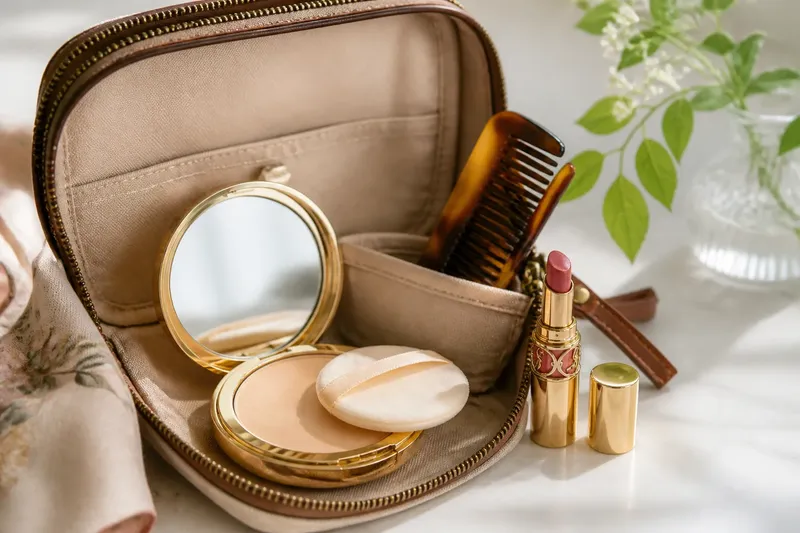
The compact case made powder easier to carry as a single, enclosed object. Its influence on the makeup bag is clearest in its design: a shell could hold product, a puff, and sometimes a mirror, inviting a different arrangement from separate containers and tools.
How did the compact case change the makeup bag?
Powder containers have taken different forms across periods and settings, so it is too broad to say that powder was once kept mainly in large dressing-table vessels. What the compact makes visible is a particular design choice: putting powder and, in some cases, an applicator into a case intended to be carried.
That arrangement reduced the number of separate pieces a user needed for a touch-up. A closed case could help keep powder from rubbing against loose objects, while an interior compartment or fitted space could keep a puff with it. These features did not make every powder container portable or eliminate spills; they made one format more self-contained.
A compact could also give a makeup bag an organizing center. A lipstick, comb, or brow tool might be placed beside it, while the compact’s thickness and closure determined what fit comfortably. This is a design relationship, not proof that every user arranged a bag in the same way.
Which features made a compact useful to carry?
Look at the case itself rather than assuming all compacts shared the same construction. A hinge helps connect lid and base; a clasp or snap keeps them together when shut. A mirror in the lid can replace a separate hand mirror, while a pan holds pressed powder and a compartment may store an applicator. Some cases omit one or more of these features.
Materials and decoration also vary. Metal, plastic, and decorated finishes can change how a case feels and looks, but ornament alone does not explain its practical value. For daily use, a secure closure, an interior suited to the product, and surfaces that can be cleaned matter more than elaborate decoration.
Not every detail deserves effort: polishing a case constantly for display is less useful than checking that its hinge works, its closure stays shut, and its interior is clean enough for the product it holds.
How can you assess a compact’s place in a bag?
- Check whether the case closes securely; if it stays shut when handled, carry it as intended, but if it opens easily, store it in a separate pouch or leave it at home.
- Check whether the powder pan fits the case; if it sits firmly, use the case with that pan, but if it shifts, choose a compatible case or carry the product separately.
- Check whether the puff or applicator has its own space; if it does, keep it there, but if it shares the powder surface, place it in a clean sleeve or use a separate applicator container.
- Check whether the mirror is clear and secure; if it is, use it for touch-ups, but if it is loose or damaged, avoid relying on it and use a separate mirror.
- Check whether the case fits the bag pocket without pressing against a zipper or hinge; if it does, place it there, but if it catches or strains the pocket, move it to a larger compartment.
- Check whether the interior can be cleaned without damaging its finish; if it can, remove residue with a suitable soft cloth, but if the finish is delicate or uncertain, avoid abrasive cleaning and ask a conservator about an antique case.
Say you have an invented starting set: a compact whose clasp stays shut, a lipstick, and a small comb in a cloth handbag. You notice that the comb catches on the compact’s hinge when the bag opens. You move the compact to a shallow inner pocket, place the lipstick in its sleeve, and slide the comb along the bag’s edge. The expected result is that the comb no longer catches on the hinge and the compact is easier to retrieve; the tradeoff is that the pocket is now occupied by the compact.
What do people ask about compact cases?
What is the difference between a compact and a powder box?
“Compact” commonly describes a portable case, often with a mirror or a fitted place for pressed powder and an applicator. “Powder box” is broader and can refer to containers intended for storage as well as portable use.
Why do some compacts have mirrors?
A mirror lets a user check or apply makeup without carrying a separate hand mirror. Not every compact includes one, and its presence does not by itself establish when or where a particular case was used.
How did the compact influence the makeup bag?
Its enclosed format brought powder and sometimes an applicator together in one object. That design could affect how other items fit beside it, although individual bags and routines varied.
Are modern powder cases still compacts?
Many pressed-powder cases retain the compact’s basic arrangement: a portable shell around a product pan, sometimes with a mirror or applicator. Materials, closures, and refill systems differ from case to case.
What can a compact case tell you about beauty history?
A compact shows how container design can shape the practical use of cosmetics without determining everyone’s habits. When examining a case, note its closure, interior, mirror, and applicator space, then distinguish those observable features from broader claims about how common or influential the object was.
The same care helps when choosing a compact today. The search phrase “compact case changing makeup bag” points to more than portability: it also raises questions about what a case protects, what it replaces, and what it asks you to carry alongside it.